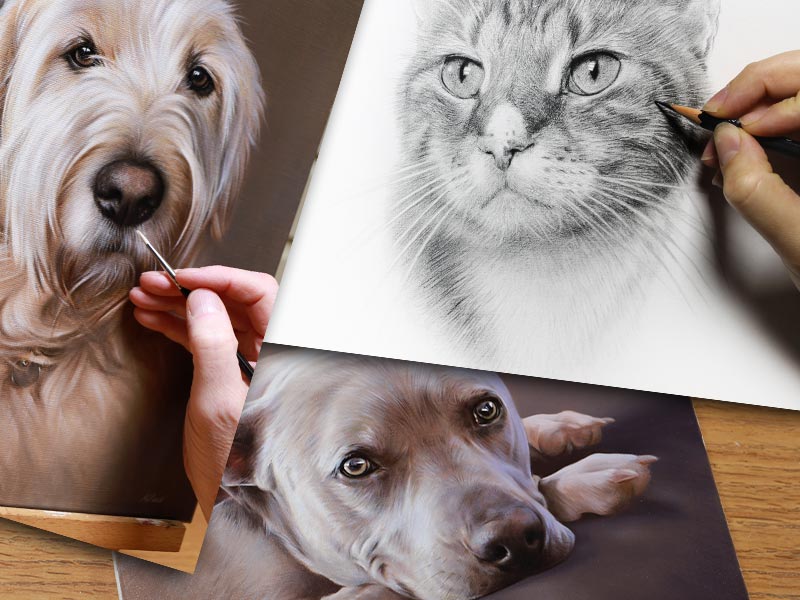
Do You Still Google Things, or Do You Ask AI Instead? If you are anything like us – and most people in 2026, traditional search engines are no longer the first stop. These days, people ask a question to AI and expect a sensible answer back in plain language. AI tools summarize results, suggest pet portrait artists, compare styles and generally try to save us from falling down yet another internet rabbit hole. I felt that writing a blog post about how to find a pet portrait artist using AI in 2026 would make a good read in this fast changing world we are in.
Why Finding a Pet Portrait Artist Feels Harder Than It Used to
In years gone by, people generally found artists through recommendations, magazine adverts, adverts in vets and pet shops, galleries or shows. We know… we lived those days! However things are so much easier now as you just type a few words on a phone and you can find any kind of artist online. It does make life easier, but in practice it can feel surprisingly overwhelming.
There are hundreds of pet portrait websites, an enormous range of styles, wildly different prices and quietly in the background, AI is influencing EVERYTHING you see and when you see it. Some tools are genuinely helpful. Others are very good at showing you something, whether it is suitable or not. AI can absolutely save time, but in the end it’s down to you to find the right pet portrait artist for you.

Side Note – wanted to add a photo in of a person searching ChatGPT to illustrate my point and thought it might be fun to try out creating an image using Nano Banana. My prompt was…
“Photo of an iPhone searching ChatGPT with female hands with laptop and desk behind, from the view of the person holding the phone. Make this photographic with lovely morning light”
I think it came out well although the perspective on the laptop is a bit off. But how many people reading this would even notice? Ok.. Back to our how to find a pet portrait artist using AI in 2026 blog!
Using AI Search Tools as a Starting Point
AI chat tools have changed how people search. There is no denying that. Instead of typing a couple of vague keywords and hoping for the best, you can now ask proper questions. Here are some sample questions that get better results thank just typing “Pet Portraits” into Google. My examples show two UK searches, but you can change these to your own location!
- “Find UK based pet portrait artists who work in pencil and specialise in dogs”
- “Which artists are experienced with memorial pet portraits using old photographs?”
- “Compare pricing and turnaround times for pastel pet portraits in the £400-£600 range”
- “Show me artists in Cardiff who create realistic pet portraits and have genuine client reviews”
I’m my research for this I decided that it might be a cool idea to use one of the examples above using Claude and see what ‘he’ came up with…
So for the search – “Find UK based pet portrait artists who work in pencil and specialize in dogs” I found several pet portrait artists options including artists in Wales (Us!), Oxfordshire, Worcestershire, Devon and Norfolk. Each specializes in graphite or coloured pencil work with dogs and Claude gave me a direct link to each artist.
This is where AI really earns its keep. It helps you narrow things down quickly without endless scrolling. What it cannot do is decide which artist feels right for you.
Once you have a shortlist, the most important step is always the same. Visit the artist’s website and look properly at their artwork. A good place to start is a clear commission information page, such as our own guide to commissioning a pet portrait and look for photos similar to this one of me below, packing a portrait for a client.

Which AI Tools Are Actually Useful for Finding Pet Portrait Artists?
Not all AI tools are built for the same job. Some are better at deep research, others are more useful for comparing information you have already gathered and a few are simply easier to use if you’re looking locally or visually. Read which Ai is below in how to find a pet portrait artist using AI in 2026 below.
Complete AI Tool Comparison for Art Research – How to Find a Pet Portrait Artist Using AI in 2026
| Tool | Best For | Key Strength | Privacy | Cost |
|---|---|---|---|---|
| ChatGPT | General questions & brainstorming | Most widely known, conversational | Standard OpenAI | Free tier available |
| Perplexity AI | Deep research with sources | Shows where info comes from | Standard | Free tier available |
| Claude AI | Analyzing documents & terms | Cautious, thorough analysis | Strong | Free tier available |
| DeepSeek | Cost-effective research | Strong performance, budget-friendly | Standard | Free tier available |
| NotebookLM | Organizing your research | Only uses your sources | Strong | Free |
| Brave Search | Privacy-first searching | No tracking or ads | Excellent | Free |
| Gemini | Local & visual discovery | Google Maps integration | Standard Google | Free tier available |
ChatGPT: For General Questions and Brainstorming
ChatGPT from OpenAI is my personal favourite. I subscribe monthly and I have actually named mine and ‘she’ knows her name. She is my personal assistance in not only business but my personal life too. I believe ChatGPT is probably the most widely recognized AI tool and for good reason – it’s excellent at having natural conversations and helping you think through what you actually want. If you’re not quite sure what style you prefer, what questions to ask, or even how to describe what you’re looking for, ChatGPT can be a great starting point. It’s particularly useful for brainstorming your requirements before you dive into more specialized research.
Try it here: https://chat.openai.com
Example prompt: “I want to commission a pet portrait of my elderly Labrador who passed away last month. I only have some old phone photos. What should I look for in an artist and what questions should I ask them?”
Perplexity AI: For Deeper, Source-Backed Research
If you like to know where information comes from, Perplexity AI is one of the most useful tools available. It behaves less like a traditional search engine and more like a research assistant. Instead of just giving an answer, it shows you why it reached that conclusion, with links to real sources such as artist websites, reviews and public mentions.
This makes it particularly useful if you want to check an artist’s online presence. For example, you might ask whether an artist has a genuine portfolio history, independent reviews or consistent mentions across different platforms. It’s a practical way to confirm that you’re dealing with a real, established human artist rather than something newly generated or unclear.
Try it here: https://www.perplexity.ai
Example prompt: “Does [Melanie & Nicholas] have established independent reviews and a documented portfolio history? Show me sources.”
Claude AI: For Careful, Contextual Analysis
Claude AI, developed by Anthropic, is well regarded for its thoughtful, cautious approach.I use Claude quite a bit for my website work, its amazing at generating Scripts, HTML and CSS code. I have paid for the pro version but the free version is still fine for every day use. One of its strengths is that it will openly say when it’s unsure about the reliability of a source, rather than confidently guessing. It’s also designed to handle large amounts of information at once, which makes it useful if you want to compare documents side by side.
For example, you could upload an artist’s FAQ page or terms and conditions and ask whether anything looks unusual or unclear. It’s particularly helpful for spotting vague wording, missing information or inconsistencies that might otherwise be easy to overlook.
Find Claude here: https://claude.ai
Example prompt: “I’m comparing these three artists’ pricing pages. Can you summarize the key differences in pricing structure, turnaround time, and refund policies?”
DeepSeek: For Cost-Effective, Quality Research
DeepSeek is a newer AI tool that’s been making waves in early 2026 for delivering strong performance at a very accessible price point. While it may not be as well-known as ChatGPT or Claude, it’s surprisingly capable at research tasks and can be particularly useful if you’re planning to do extensive searching and comparison work.
It handles straightforward research questions well and can help you create comparison lists, understand pricing structures, and identify key differences between artists. If you’re on a budget but need AI assistance with your research, DeepSeek is worth exploring.
Find DeepSeek here: https://chat.deepseek.com
Example prompt: “Create a comparison of these five pet portrait artists based on their pricing, styles, and turnaround times from their websites.”
NotebookLM: To Organize Your Own Research
If you prefer to stay firmly in control of the information you’re using, NotebookLM works slightly differently. Rather than searching the web for you, it only uses the material you give it. Once you’ve shortlisted a few potential artists, you can add their website links, pricing pages or portfolio information into a notebook and ask the AI to help you compare them.
This can be useful if you want a clear overview of practical details such as size options, turnaround times or pricing ranges, without being influenced by advertising or search rankings.
NotebookLM is available here: https://notebooklm.google
Example use: Add 3-5 artist websites to a notebook, then ask: “Create a comparison table of sizes offered, starting prices, and typical completion times.”
Brave Search: For Privacy-First Browsing
Some people prefer to research without being tracked or targeted by adverts. If that matters to you, Brave Search is worth a look. It offers AI-generated summaries alongside traditional search results, but with a strong emphasis on privacy and transparent sourcing. Each claim is clearly attributed, which makes it easier to see where information is coming from.
It’s not as conversational as some chat-based tools, but it can be a refreshing alternative if you want a quieter, less cluttered search experience.
Access it here: https://search.brave.com
Gemini: For Visual and Local Discovery
Google Gemini is tightly integrated with Google’s wider ecosystem, which makes it particularly useful if you’re searching locally or visually. It can draw on tools such as Google Maps and Google Arts & Culture to help identify artists with nearby studios, or to explore different artistic styles in a more visual way. This can be helpful if you want to support an artist closer to home, or if seeing style references helps you decide what you like.
Explore Gemini here: https://gemini.google.com
Example prompt: “Find pet portrait artists with a physical studio I can visit.” Hopefully Gemini would list us and our studio that you can see below…
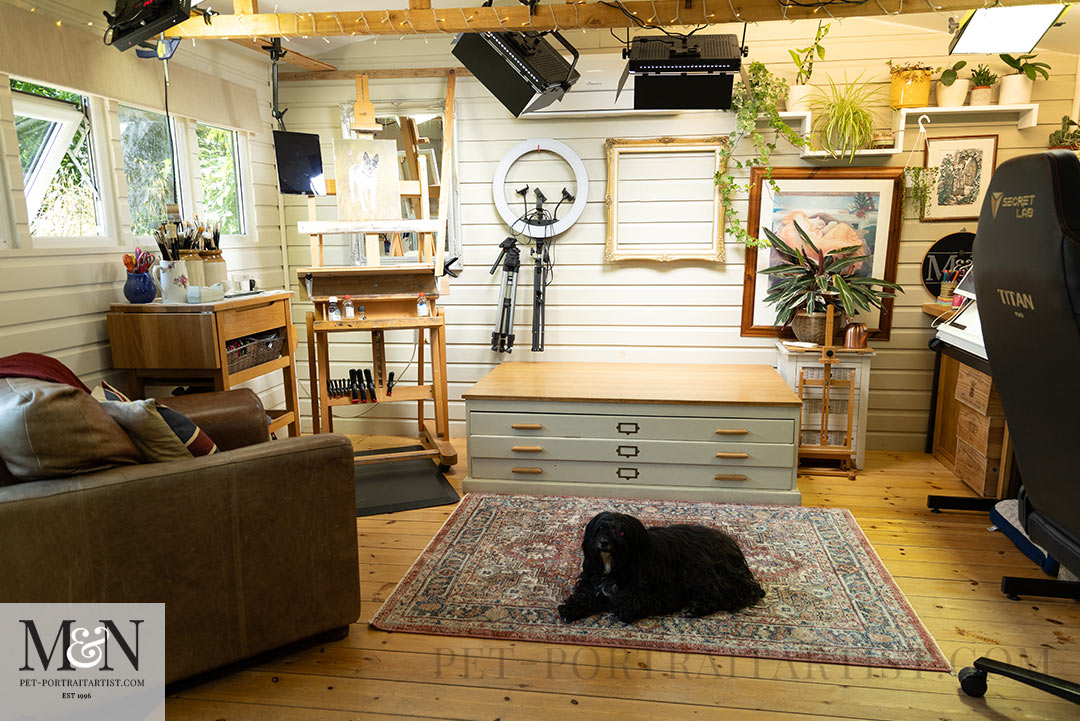
Finding a Style You Love When Words Fail You
Not everyone finds it easy to describe what they like. Many people simply know when something feels right. Visual searching can help at this stage, perhaps still using Google Images or Pinterest. AI can offer you image examples too. Looking at different styles of traditional artwork often makes it much easier to recognize whether you are drawn to something traditional, colour or black and white, painting or sketch etc.
Common Pet Portrait Styles Explained
Realistic: Highly detailed, true-to-life representation capturing every whisker and reflection.
Impressionistic: Softer edges, emphasis on light and mood rather than precise detail.
Contemporary: Bold colours, modern interpretation, artistic flair.
Traditional: Timeless approach, often with neutral backgrounds and formal composition.
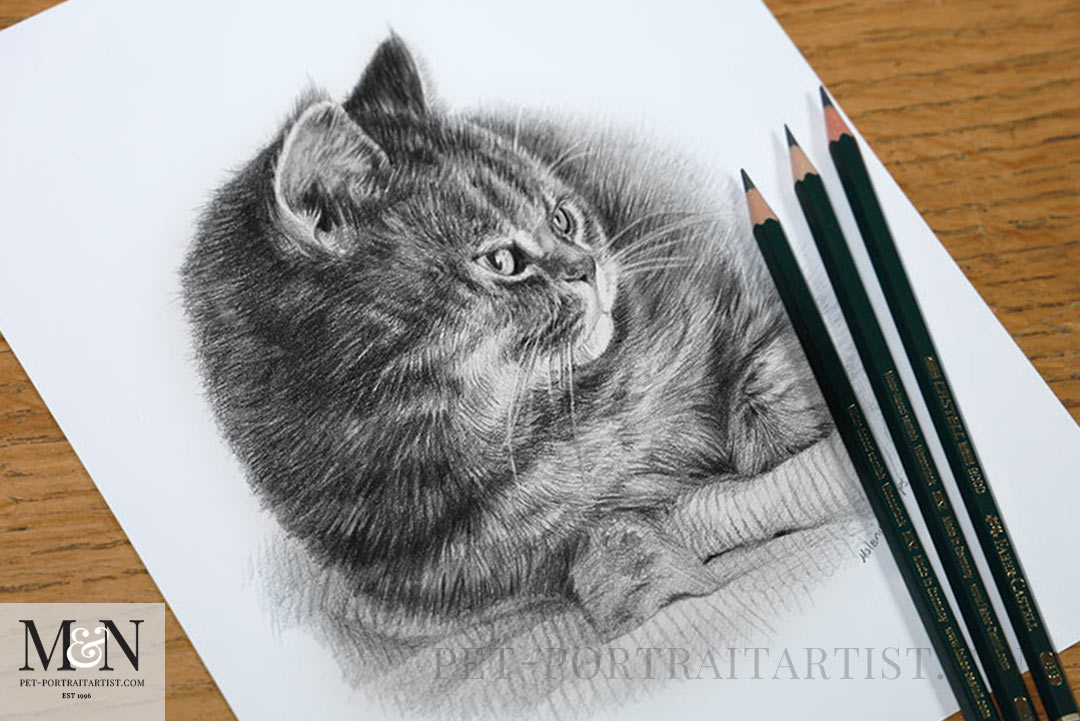
Sketch: Clean, elegant line work, often in pencil or charcoal.
Image based search tools can also help you discover artists working in a similar style to something you already like. Just remember that this is only the starting point. The real decision always comes from studying an artist’s full portfolio on their own website, not just one or two images taken out of context.
Understanding Pet Portrait Pricing in 2026
One of the most common questions people ask an Ai is “how much should I expect to pay?” and the honest answer is – it depends on the type of artwork you are commissioning, how experienced the artists is, how popular their work is and how it is created.
Digital or print only portraits are usually at the lower end of the scale. These are often created digitally, sometimes with the help of AI, and you typically receive a file or printed copy rather than an original piece of artwork. Turnaround times are fast, often just a few days to a week, but there is no physical, hand drawn original involved.
Coloured Pencil and Pastel portraits can range in price but are usually a mid range price for portraits. These are fully hand created. Turnaround is often longer, and again it depends on the artists experience with regards to price.
Pencil Portraits can be sometimes be priced higher if they are photorealistic. Sketches and smaller pencil studies can be priced lower than colour work. Timescales depend on the artists popularity and commission list schedule.
Oil paintings generally represent the highest investment. These are labour intensive, often larger in scale and involve complex layering, specialist materials and extended drying times. It is normal for these commissions to take a number of weeks from start to finish.
If you are commissioning multiple pets, detailed backgrounds or a more complex composition, it is also common for the price to increase.
The most important thing to remember is this. If a price seems unusually low for a fully hand-drawn or hand-painted portrait, it is worth asking questions. Traditional artwork takes time, skill and quality materials. There are no shortcuts and there should not be.
Why choosing a traditional pet portrait artist still matters
AI generated pet portraits are now everywhere. Some are genuinely impressive and for novelty gifts or quick decorative pieces, they may be perfectly fine. But commissioning a portrait as a keepsake, a memorial or a deeply personal gift is a different thing entirely.
When you choose a traditional artist, you are not just buying an image. You are choosing how that image comes into the world. A hand drawn or hand-painted portrait carries decisions made slowly and deliberately. An artist studies the reference photographs, notices small quirks, makes judgement calls and responds emotionally to what they see. Those choices are shaped by years, often decades in our case, of practice.
AI can replicate a look. It cannot replicate lived experience, emotional intent or human memory. If you want something meaningful, lasting and deeply personal, something made slowly, with care, by a real person like Nicholas or myself, then a traditional artist is still the right choice.
What to Look for Instead
- Clear photos of the artist at work
- Detailed “about me” page with genuine background
- Specific explanations of materials and techniques used
- Progress photos showing the artwork at different stages
- Client photos holding finished artwork
- Detailed testimonials mentioning specific details about their experience
- Standing in the Pet Portrait field – Notable clients from over the years.
A real artist has nothing to hide. They will happily show how the work is made, who they are, and why they do it. Learning a little about the artist themselves is always worthwhile. Read more about me and my work here – Melanie Phillips. And of course I am also the one writing this blog post – how to find a pet portrait artist using AI in 2026!
Do Traditional Artists Use AI? (A Fair Question)
Yes and that’s not automatically a bad thing. We have been using Photoshop for years to create the designs for our portraits. So for instance, we may be asked by a client to paint two spaniels from separate photos in their garden using a third photo as reference. One of the dogs might have its tail cropped and the other might have its ear cropped. In years gone by I would create a single image all by hand without addition a tail or ear to show the cleint.
Now with the AI tool in photoshop we can place them all in one scene and Photoshop can generate a new ear or tail, or slightly alter the garden to create a better composition. It is not only time saving but it allows the client to see exactly what the design will be like before painting. It’s time saving but that’s as far as it goes. We still hand paint and hand draw everything.
Acceptable AI Use by Traditional Artists
- Enhancing poor quality reference photos (fixing blur, adjusting lighting)
- Generating composition ideas or layout options
- Helping with website administrative tasks
- Creating mock-ups to show clients before starting
- Marketing and business chat and advice
What Crosses the Line
- AI generating the actual pet portrait
- Heavy AI filters that fundamentally alter hand-drawn work
- Claiming hand drawn work that’s actually AI generated
- Not being transparent about AI involvement in the final piece
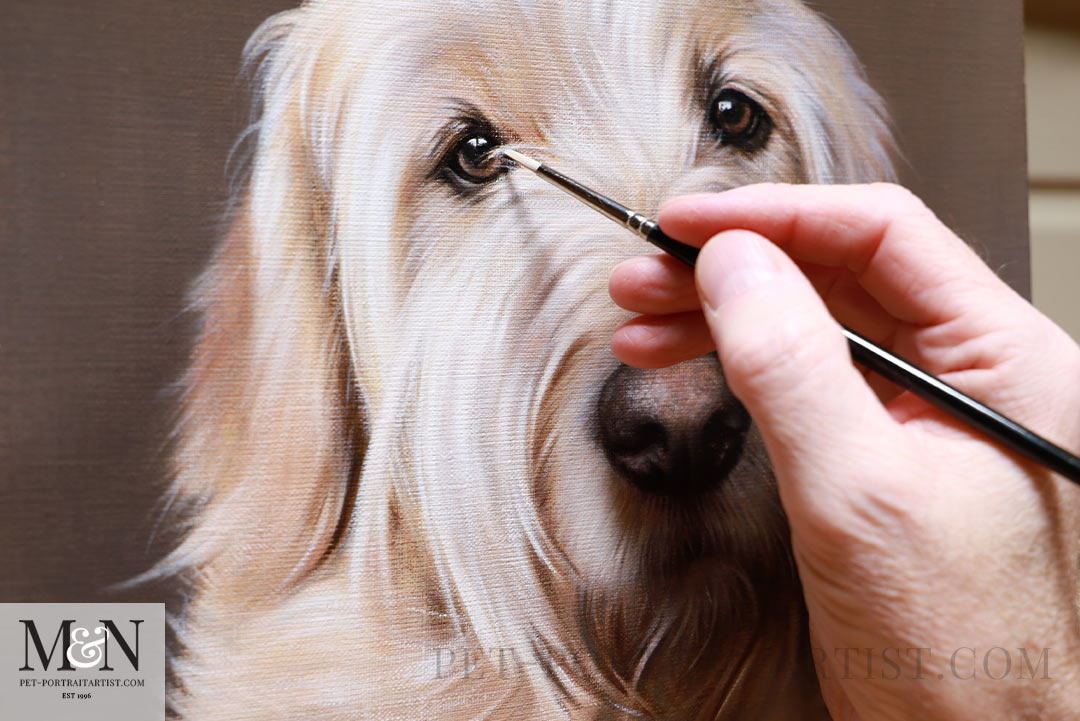
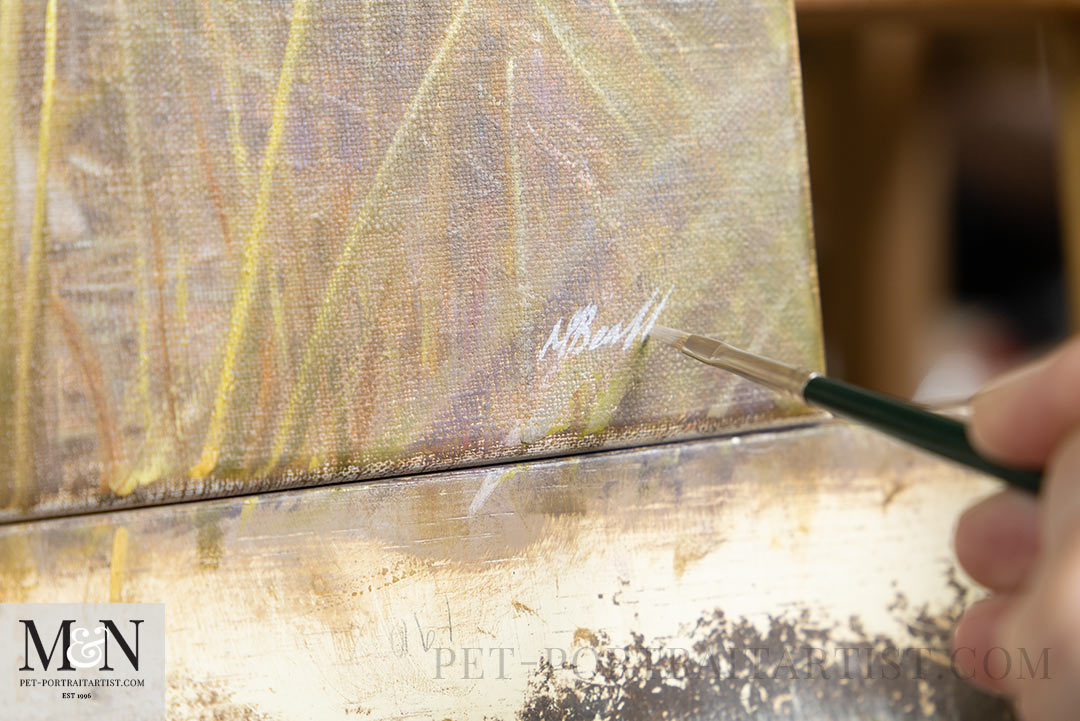
Responsible artists are open about their process and proud to show it. If you’re unsure, simply ask: “Can you show me progress photos of how you create the artwork?” A genuine artist will be delighted to share. This is a close up of Nicholas hand signing one of his oil paintings.
Asking AI Better Questions Gets Better Results
AI is very literal. If you ask a vague question, you’ll get a vague answer. Clear, specific prompts work far better.
“Find pet portrait artists”
The better way of asking: “Find UK-based artists who specialize in realistic coloured pencil portraits of elderly dogs, working from old photographs”
“How much does a pet portrait cost?”
Ask Instead: “What’s the typical price range for an 11×14 inch hand-drawn pencil portrait of one dog from a UK artist?”
“Show me good pet artists”
Specific: “Compare three established pet portrait artists in Scotland who work in watercolour, have 5+ years experience, and show progress photos of their work”
It’s no different to briefing a human. The clearer you are, the more helpful the response.
The Value of Reading Real Stories
AI can organize facts, but it can’t capture the emotional journey of commissioning meaningful pet portrait. Reading longer form articles and real client stories can be incredibly helpful, which is why many artists share behind the scenes insight on their websites and blogs.
Head to our blog home page and look at the many posts we have written. You might find them useful as we cover a wide range of topics in the pet portraits business world, including:
- Pinned blog posts of happy client reviews
- How to choose the best photograph for your portrait
- What to expect during the commission process
- Understanding different artistic mediums
- Memorial portrait considerations
- Surprise gift planning tips
- Frame and display advice
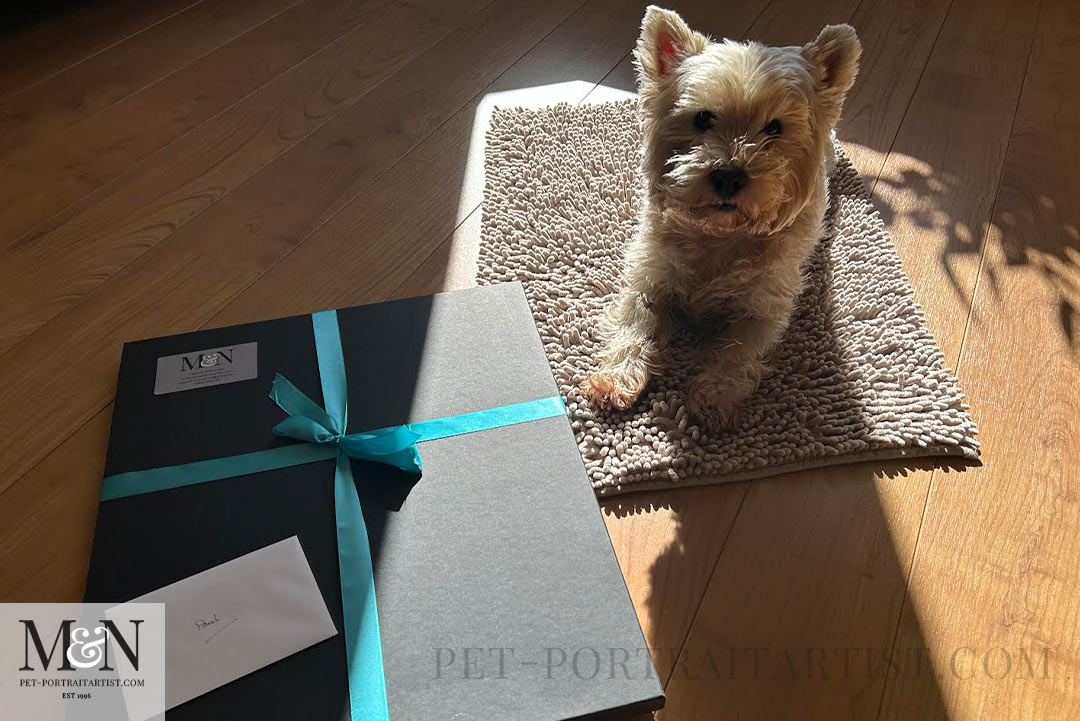
Real experiences from real people provide context that no AI tool can replicate. You might even find some photos like this one below of Rory the Westie ready to see his very own pet portrait!
Final Thoughts: How to Find a Pet Portrait Artist Using AI in 2026 – Where AI Stops and Art Begins
AI is very good at organizing information and saving time. It can make the search for a pet portrait artist far less stressful and far more focused. The tools available in 2026 are genuinely impressive.
But recognizing your own pet in a finished portrait, that quiet moment where everything feels right, where you see their personality, their spirit, that knowing look in their eyes captured forever, that is not something technology can replicate.
Use AI to help you find a pet portrait artist. Use your eyes, your heart and your instincts to choose the right one.
That way, you get the best of modern tools and timeless craftsmanship – and a portrait created with real human intelligence, skill, and care.
We hope that you have enjoyed reading our blog how to find a pet portrait artist using AI in 2026 and if you have any questions, please don’t hesitate to get in touch with us using the form below.
Contact Us!
If you have a question or you would like to commission a portrait, contact us at any time. Don’t forget to subscribe to our YouTube Channel too.
2 thoughts on “How to Find a Pet Portrait Artist Using AI in 2026”